
- Complete a Questionnaire: The homeowner will fill out a form providing basic information about the system's history and location. This includes septic use permits, holding tank pump contract and advanced treatment unit maintenance contracts. There is an online form available Septic Re-Inspection Questionnaire.
- Schedule an Appointment: An inspector schedules a time for an onsite visit. Email Septic Re-Inspection Program.
- Ensure Access & Safety: The homeowner ensures clear access to the septic tank and the drain field area and removes any potential hazards. All tank lids (including pump chambers) to be exposed prior to appointment. Most septic tanks have 2 lids.
- Septic Re-inspection cost is $220.00.
Septic Re-Inspection Information
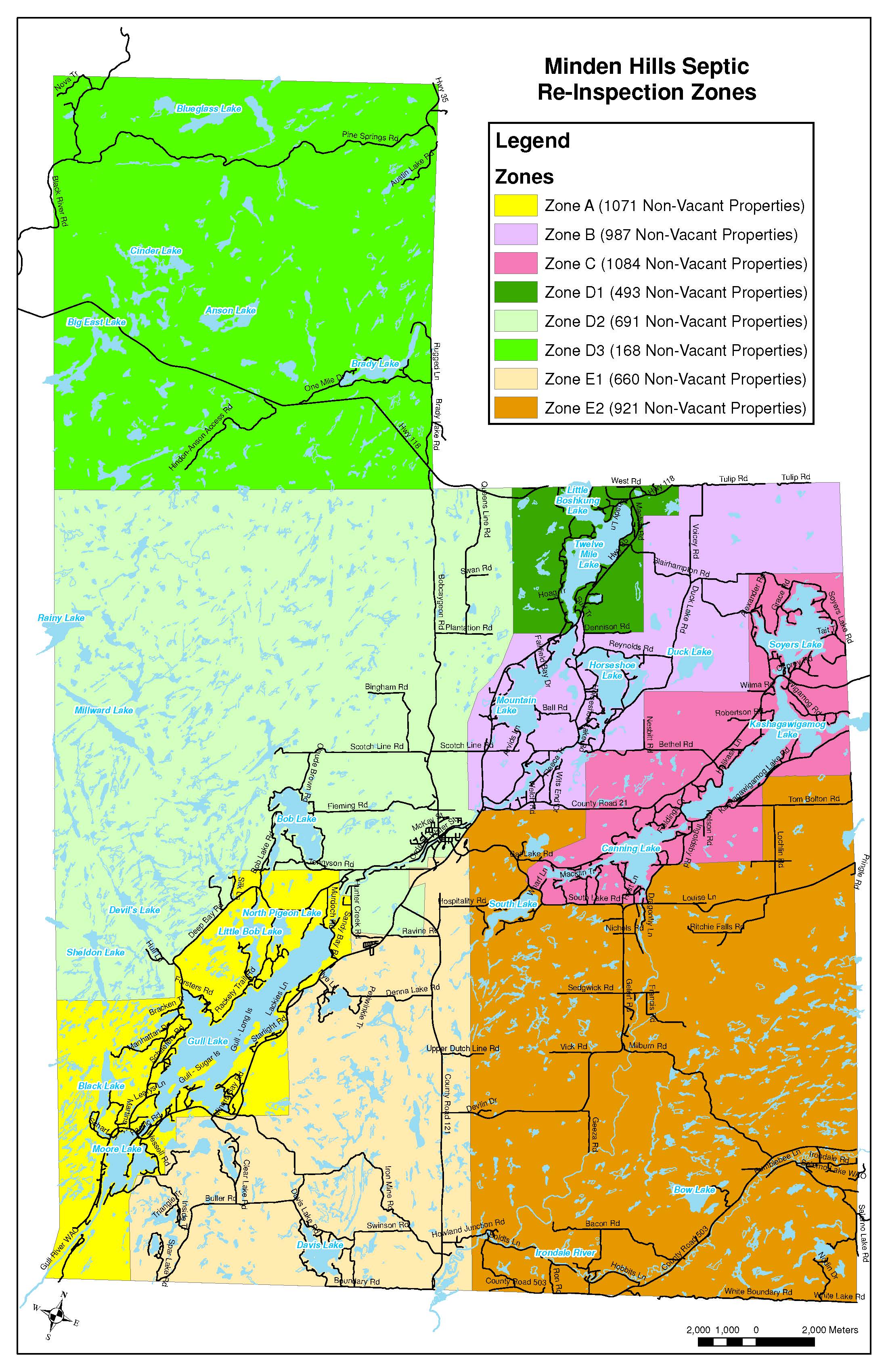
In 2021, the Township of Minden Hills started the Septic Re-inspection Program. The Municipality was divided into five (5) Zones for inspection purposes. The first three (3) Zones in the Septic Re-inspection Program have been completed. In 2026, we will be continuing the program with carrying out septic re-inspections within Zones D1 and D2.
View the Septic Re-Inspection Zones: Septic Re-Inspection Zone Map
If your property falls within these zones, you will receive a letter at the end of March 2026 with information including scheduling, contact information and a questionnaire. The Septic Re-inspection cost is $220.00.
Please be advised that if you have a metal septic tank, holding tank or pump chamber you will be required to replace them with the benefit of a building permit. Please contact the building department for a tank replacement permit prior to April 15, 2026.
There will be more information added to the website and provided in the coming months as we gear up to continue with the Septic Re-inspection Program.
Septic Systems, when properly designed, installed and maintained, effectively reduce or eliminate most human health and environmental threats posed by pollutants in household wastewater. However, they require regular maintenance or they can fail.
Failed systems pose a serious public health risk and can contaminate the surrounding ground and water. Even enter drinking water systems far beyond property boundaries. There is a significant potential to cause serious illness and even death.
Property owners should have their systems inspected every 3 to 5 years. Ontario Building Code regulation 350/06 regulates and governs administration of mandatory and discretionary on-site sewage system maintenance inspection programs. This change to the Ontario Building Code gives public officials the responsibility for ensuring this is happening as well as the ability to take action if this is not the case.
The Township of Minden Hills is committed to ensuring that our lakes, wells and water intakes are protected and has implemented a septic re-inspection program to protect water sources, prevent illness and environmental harm, ensure system longevity and regulation compliance.
Presentation at the Septic Re-Inspection Information Session
Septic Re-Inspection Procedure
Any metal septic/holding tanks or pump chambers are required to be replaced with the benefit of a septic permit. Please apply for a permit prior to your inspection date.
A standard septic system re-inspection is a procedure conducted by qualified professionals to ensure the system is functioning correctly and does not pose environmental or health risks.
Preparation (Homeowner/Inspector)
The inspector will typically perform the following actions:
- Property Walkthrough: The inspection begins with a walk around the property to identify all components of the system, nearby water sources (wells, streams), and potential failure indicators like lush vegetation, odors, or wet spots in the yard.
- Measurement of Separation Distances: The inspector measures and records distances between the septic system components and key features like structures, wells and water bodies to ensure regulatory compliance.
- Access Septic Tank and Pump Chambers: The inspector opens the access points (lids).
- Visual Inspection of Tank Structure: The inspector checks the physical condition of the concrete or plastic tank for signs of corrosion, leaks, or damage.
- Inspect Baffles and Partition Wall: The inlet and outlet baffles (or partition wall) are checked to ensure they are present and functioning correctly to prevent solids from entering the drain field.
- Measure Tank Contents: A "sludge judge" is used to measure the levels of scum and sludge in the tank. If solids exceed a certain percentage (e.g., 33% in the first chamber), a pump-out is required.
- Inspect the Drain Field: The absorption (leaching) field is visually assessed for signs of failure, such as standing water, sewage breakout, or excessive root growth.
- Check Mechanical Components: Any mechanical equipment, such as pumps, alarms, and effluent filters, is tested for proper function.
- Document Findings: The inspector records all findings, taking photos of the components.
- Homeowner Briefing: The inspector typically briefs the homeowner on proper maintenance and operation of their system.
- Formal Report: A full digital report, including images and recommendations (e.g., maintenance needed, required repairs, pump-out frequency), is provided to the homeowner.
- Any systems found that are not maintained as per Ontario Building Code 8.9 are required to be brought into compliance. If this is not completed within set timelines, orders will be issued.
Five Classes of On-Site Sewage Systems
Five Classes of On-Site Sewage Systems
This program will include inspections of all Five (5) classes of on-site sewage systems, as regulated by the Ontario Building Code (Part 8). Some key details can be found below:
Classes of On-site Sewage Systems |
Characteristics of System |
How to Prepare for Your Inspection |
| Class 1: Privy, Outhouse, Composting Toilet, Incinerating Toilet | Only accepts human waste | Ensure structure is vermin-proof (no possible access for mice, etc., into pit through doors/walls/windows) and that the pit is not exposed at grade |
| Class 2: Greywater Systems | Only accepts greywater (wastewater that excludes human waste). | Ensure that there are no illegal discharges from the system and the system does not receive human waste. |
| Class 3: Cesspools | Only receives human waste, often used as overflow for composting toilets. | Ensure that there are no illegal discharges from the system and the system only receives human waste. |
| Class 4: Septic Tank and Leaching Bed |
Most common system: septic tank retains solids while liquid waste moves through leaching bed (also known as tile bed or filter bed). Tank is typically pumped every 3-5 years. System may have pumping tanks or other components. |
1. Expose both septic tank lids. 2. Expose pump tank lids. 3. Contact the Township if you require your permit file to locate these components. 4. Maintain short, manicured grass on your leaching bed surface. |
| Class 4: With Advanced Treatment Unit |
Similar to a standard Class 4, with additional treatment tank(s), serviced annually, will often include blowers/aeration. |
Ensure that your Maintenance Servicing Agreement is current, and that a copy is provided with the completed Questionnaire. |
| Class 5: Holding Tank |
Tank is pumped frequently (typically multiple times each year) or before it fills. There is no discharge to the environment. |
Expose the tank lid(s) and ensure your holding tank system has: 1. A high level alarm. 2. A haulage agreement with a local pumper. |
Frequently Asked Questions
Septic re-inspections can provide system owners with advice on how to ensure the system has a long and useful life as well as being proactive with respect to environmental/lake water protection.
It is recommended that you apply for a permit of a replacement system prior to April 30/26. If your holding tank, septic tank or pumping tank is made of metal, they are prone to corrosion and are structurally unsafe. Ensure that the area is kept marked-off and that any attempts to dig to expose the tanks are done so with health and safety considerations. If you do not apply for a permit of a replacement system prior to the deadline, your system will require an inspection. Metal tanks require replacement; your inspection results will provide you with a remedial action letter indicating your next steps.
What if I can only be there on a weekend?
As your presence is not required, but encouraged, for the inspection (or a representative over the age of 18) you are only required to dig up tank lids prior to inspection.
What happens if I miss my inspection?
If you do not cancel your inspection more than 48 hours before it is booked, and you are not present or not prepared when we arrives during your inspection window, an Extra Inspection Fee will apply for the missed inspection.
Do I have to pump my septic tank before the inspection?
Please do not pump the tank prior to the inspection. It is preferred that the tank remain at its normal operating level; please co-ordinate any planned tank pumping for after the scheduled inspection.
What if I have an old system that I no longer use? (i.e. Outhouse)?
All Classes of septic systems must be inspected if they are still in a state that could possibly be used; this can include an old outhouse being used as a storage shed, or a septic tank that still has plumbing connecting the system to the building and is not decommissioned.
What is considered 'sufficient clearance to remove lid(s)"?
The earth must be removed above the lid(s) and a perimeter large enough for the inspector to use a crowbar to shift or lift the lid(s) off, approximately 1 square meter (10 square feet).
If the lid(s) are under a deck then there must be a hatch installed or planks removed to allow the inspector vertical space above the lids to complete the inspection fully, approximately 2 meters (6.5 feet).
What type of system do I have? Where are the lid(s) located?
Contacting the Township of Minden Hills for permit details is one method for determining what system is present. If the location of the tank lid(s) is unknown then locate the outlet pipe from the house; the septic tank typically begins a minimum of 1.5 meters (5 feet) from that point and the lids may be buried between 0.3 meters to 1 meter under the soil. Look for disturbed or dead patches of grass, or call a pumper, plumber or septic installer.
Township of Minden Hills
Septic Re-Inspection Program
7 Milne St., Minden, ON K0M 2K0
T: 705-286-1260 ext. 517
Email
Sign up for Minden Hills News
Stay up to date on the Township's activities, events, programs and operations by subscribing to our News.